
Submitting a visa application for Belgium from a country where you do not reside, via an outsourced center like TLS Contact, exposes you to varying requirements depending on the collection location. The requested documents, appointment slots, and response times differ in Dakar, Kinshasa, or Istanbul. Here, we rely on the official Belgian procedures to identify critical points and limit the risk of refusal or processing delays.
Submission via an outsourced center in a third country: pitfalls to know
When you do not submit directly at the Belgian embassy in your country of residence, the processing chain lengthens. The collection center (TLS Contact or equivalent) forwards the application to the competent embassy, which may itself request the Office of Foreigners in Brussels. Each intermediary adds a delay and a verification filter.
The sensitive point: the required documents vary depending on the submission center. Proof of legal residence in the third country is almost always required in addition to the standard application. If this document is missing, the application may be declared inadmissible even before being forwarded to the embassy.
Before making an appointment, you should systematically check the list of required documents on the website of the outsourced center in the relevant country, not that of your country of nationality. Responses vary on this point depending on the consular posts, and a list valid in Abidjan may not necessarily be valid in Nairobi.
To better understand the complete procedure, the visa application for Belgium details each step of the administrative process with the associated timelines.
Short-stay visa or long-stay visa in Belgium: two distinct procedures
Confusing the two categories of visa is one of the most common mistakes, and it can cost several weeks. The Schengen short-stay visa covers a stay of up to 90 days within 180 days in the Schengen area. The long-stay visa (visa D) pertains to stays beyond 90 days, particularly for studies or family reunification.

Processing times and supporting documents differ entirely between these two categories. For short stays, the decision is generally made within 15 calendar days following the submission. For long stays, processing always goes through the Office of Foreigners, which significantly extends the waiting time.
The financial documents illustrate this difference well. A short stay requires proof of financial coverage for the duration of the trip. A long stay for studies requires proof of solvency or a scholarship covering the entire academic year, plus a validated enrollment from the institution.
Submission window for the Schengen short-stay visa
The application can be made no earlier than six months and no later than fifteen calendar days before departure. Outside of this window, the application is simply refused at the counter. It is recommended to submit at least four to six weeks before the trip, especially during peak periods (summer, year-end holidays, school vacations).
Assembling a complete application to avoid processing delays
An incomplete application is the primary factor in lengthening processing times. Belgian authorities explicitly mention this: when additional verification is necessary, the standard 15-day timeframe can be extended up to 45 calendar days.
Here are the documents that most often pose problems during the admissibility check:
- Proof of accommodation: a cancellable hotel reservation is not always sufficient; some posts require a signed accommodation certificate from the host in Belgium along with a copy of their ID card
- Travel insurance: it must cover the entire Schengen area with a minimum of medical coverage, and its validity must cover the entire duration of the requested stay
- Return guarantees: return ticket, ongoing employment contract in the country of residence, property title or rental lease, school enrollment certificate for children
- Financial coverage: recent bank statements showing regular transactions, not just a high one-time balance that could appear artificial
Return guarantees are the most scrutinized point by the Office of Foreigners. The goal is to demonstrate sufficient ties to the country of residence so that the migration risk is deemed low.
Common mistakes on the application form
The Schengen visa application form includes fields about the purpose of the trip and the exact dates of stay. A discrepancy between the declared dates and the transport or accommodation reservations almost systematically triggers a request for additional documents.
Another pitfall: filling out the form for a stay in Belgium while most of the trip takes place in another Schengen country. The visa must be applied for from the main destination country, that is, the one where you will spend the most days. Mistaking the competent country results in a straightforward rejection.
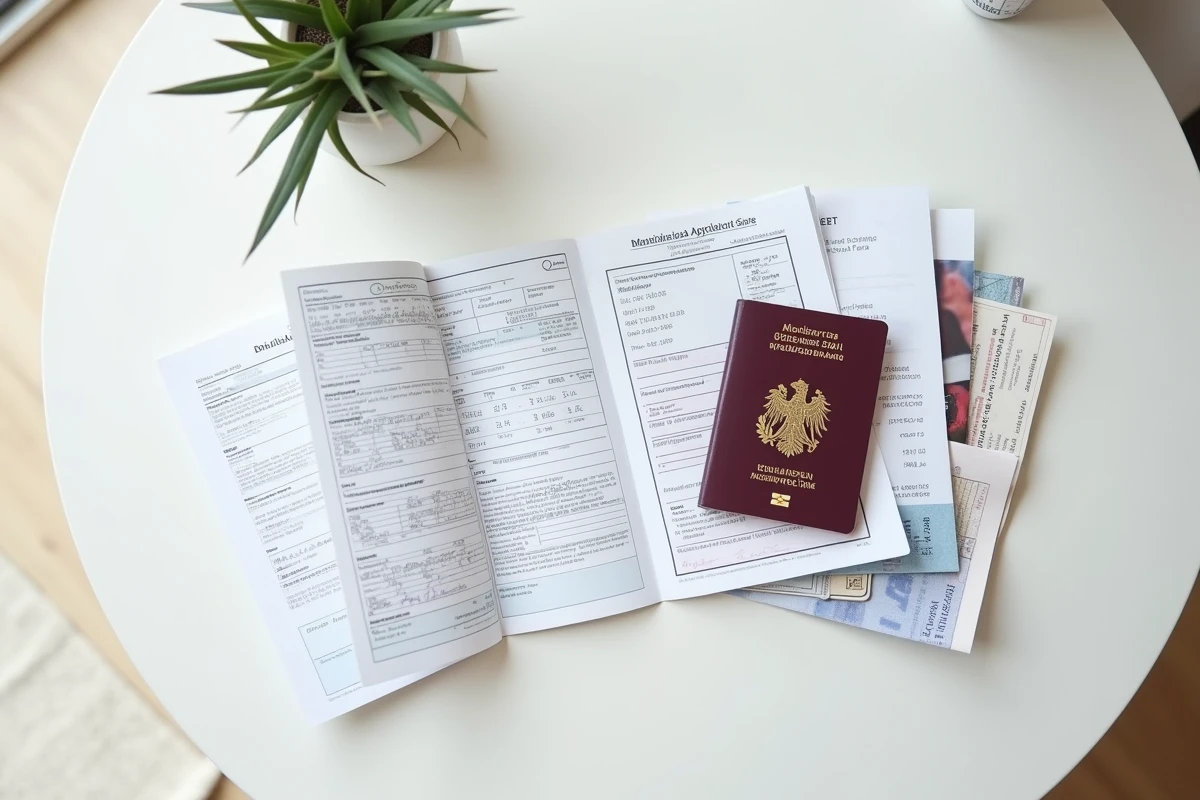
Processing times for the Belgian visa depending on the complexity of the application
The official framework is clear on processing times. For a Schengen short-stay visa, the decision is generally made within 15 calendar days when the application is complete and does not require in-depth consultation. The embassy or consulate can then grant the visa without consulting the Office of Foreigners.
When additional examination is required (consultation with other Schengen states, verification in databases, doubt about a document), the timeframe can extend to 45 calendar days. During peak periods, these times are regularly exceeded, without the applicant having any recourse to expedite the process.
For long-stay visas, no strict regulatory timeframe applies in the same way. Processing by the Office of Foreigners depends on the type of application (studies, family reunification, work) and the current workload. Anticipating submission by several months remains the only reliable strategy.
A well-prepared application from the start, submitted within the correct timeframe and at the right consular post, remains the main lever to obtain a Belgian visa within the announced timelines. Each missing or inconsistent document delays the decision and reduces the margin for maneuver before the planned travel date.