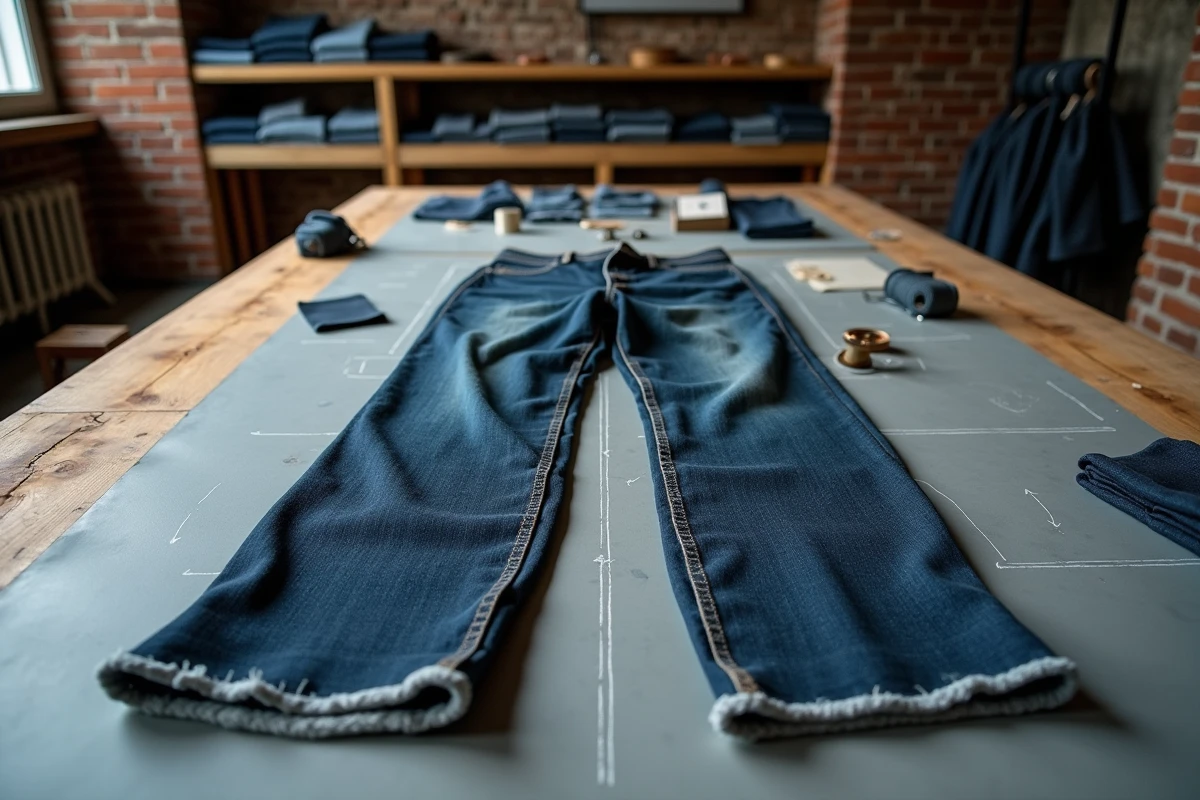
A pair of jeans travels from one continent to another before arriving in your wardrobe. Between the cotton field, spinning, weaving, dyeing, manufacturing, and distribution, this simple pair of pants accumulates distances that most travelers will never cover in a lifetime. This journey, rarely visible on the label, tells a lot about how the global textile industry operates.
Raw cotton, the first link in an intercontinental journey
Before becoming fabric, cotton must be harvested, ginned, and then shipped to a spinning mill. These three steps rarely take place in the same country.
Cotton can be grown in Central Asia or West Africa, then transported by cargo to a spinning mill located in Southeast Asia. The fiber obtained then goes to another site for weaving. At this stage, the raw material has already crossed several borders and traveled thousands of kilometers, without a single stitch being sewn.
Have you ever noticed that the label on your jeans mentions a manufacturing country, but never the origin of the cotton or the place of weaving? That’s because regulations only require mentioning the last assembly country. The entire upstream journey remains invisible to the consumer.
When trying to understand how many kilometers a pair of jeans travels, the most commonly cited figure is around 65,000 km, which is more than one and a half times around the Earth. This total covers all movements, from the cotton field to the retail store.

Indigo dyeing and washing: steps that add thousands of kilometers
The characteristic blue color of jeans is not obtained in the same place as weaving. Indigo dyeing requires specialized chemical infrastructures, often concentrated in a few regions of the globe.
Once the fabric is dyed, it still needs to be washed to achieve the worn effect that fast fashion brands offer at low prices. This washing can involve sand, ozone, or laser processes, depending on the desired finish. Each technique requires different equipment, sometimes located in a country distinct from where the fabric was dyed.
In practice, denim dyed in Pakistan may be shipped to Bangladesh for manufacturing, then sent to another site for washing, before heading to a distribution warehouse in Europe. Each geographical specialization adds a maritime or air journey to the tally.
Why these back-and-forths persist
The cost of labor and technical specialization explain this dispersion. One country may offer very low manufacturing rates but lack suitable dyeing factories. Another may excel in industrial washing due to decades of investment in this specific niche.
The result: a standard pair of jeans crosses between four and eight different countries before reaching a point of sale. This fragmentation is not a logistical accident. It reflects a financial optimization taken to the extreme, where every cent saved on one step justifies an additional transport.
The brand 1083 and the model of locally sourced jeans in France
In light of this observation, some brands have taken the opposite approach to the globalized model. The French brand 1083 derives its name from a concrete promise: none of its jeans travels more than 1,083 km between the various production sites.
The principle is based on consolidating the steps (spinning, weaving, dyeing, manufacturing) within a restricted geographical area, namely French territory. Organic cotton is spun and woven in France, manufacturing is done locally, and distribution remains national or European.
- Cotton is grown or imported through short circuits, then spun in France, eliminating the first intercontinental journey
- Weaving and dyeing take place in workshops located a few hundred kilometers from the manufacturing factory
- Distribution is done from a French warehouse to retail points or online customers, without transit through an Asian logistics hub
This model significantly reduces the total distance traveled by a pair of jeans compared to the conventional model. The price to the consumer is higher, but the environmental cost of transport drops dramatically.

European regulations and reducing the hidden kilometers of jeans
The European Union has been working for several years on regulations that could transform the textile supply chain. The digital passport for textile products is part of the measures being prepared. It would require brands to document each manufacturing step, including the countries crossed and the distances traveled.
This forced traceability would change the game. Today, a consumer cannot know if their jeans have crossed six countries or two. Tomorrow, this information could appear on a digital label accessible via QR code.
What this means for brands
Brands that multiply geographical intermediaries will have to make visible what the low price concealed. Displaying 65,000 km on a product passport will become a commercial disadvantage, especially against competitors capable of proving a short circuit.
The trend towards nearshoring, meaning bringing production locations closer to the Euro-Mediterranean basin, has accelerated since the health crisis and the rise in maritime freight costs. Several denim manufacturers are now consolidating spinning, weaving, and manufacturing within the same geographical area, reducing intercontinental back-and-forths.
- Turkey, Portugal, and Italy are concentrating an increasing share of denim production destined for the European market
- Consolidating the steps within the same industrial basin can reduce the total distance traveled by tenfold
- Post-Covid logistical surcharges make this model competitive against traditional long circuits
The mileage of a pair of jeans is not a technical inevitability. It is the result of industrial choices that evolve under regulatory, climatic, and economic pressure. A pair of jeans made through short circuits travels a few hundred kilometers instead of tens of thousands. The gap between these two models is directly reflected in the carbon footprint of the garment, and soon, perhaps, on its label.